
AI Due Diligence in Healthcare M&A: A Buyer’s Compliance Checklist
- November 18, 2026
- Posted by: allan
- Categories: AI & Technology Law, Business Law, Healthcare Law
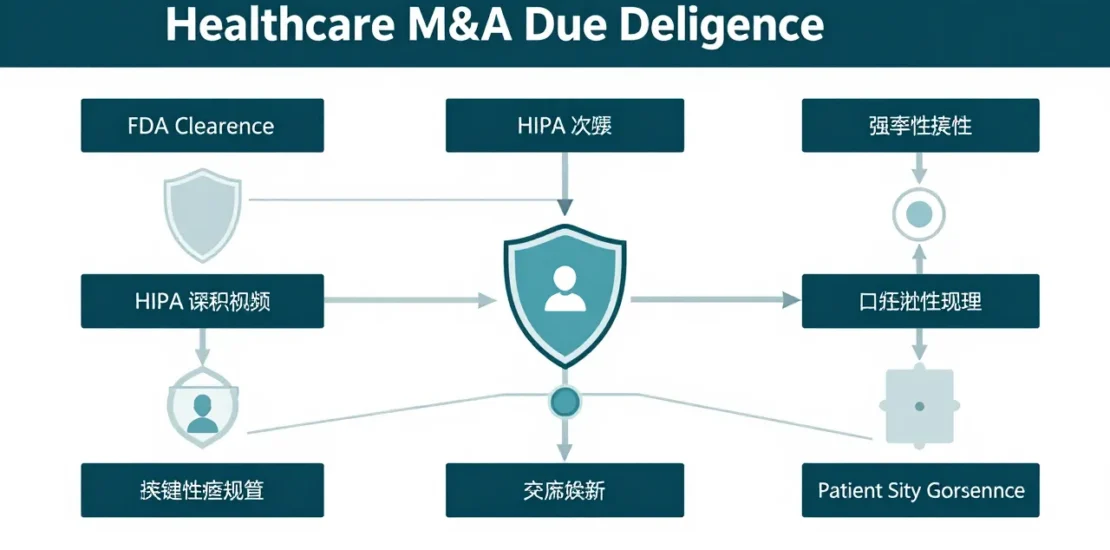
Healthcare transactions have always involved a more complex compliance diligence than most other industries. Licensure requirements, CON laws, anti-kickback statutes, Stark Law, HIPAA, Medicare and Medicaid participation conditions, and the ever-present shadow of False Claims Act liability create a compliance surface that requires specialized expertise and careful attention. Experienced healthcare transaction counsel know that the standard M&A diligence checklist needs to be materially expanded in the healthcare context.
AI has added an additional layer — one that is both structurally new and rapidly evolving. Healthcare organizations are deploying AI across the full spectrum of clinical and administrative operations: diagnostic imaging analysis, clinical decision support, ambient AI documentation, revenue cycle automation, prior authorization management, scheduling optimization, and patient communication. Each of these deployments carries its own compliance profile, and collectively they create a due diligence surface that most healthcare acquirers are not yet systematically covering.
False Claims Act recoveries hit a record $6.8 billion in fiscal year 2025, with over $5.7 billion arising from healthcare matters. The DOJ has explicitly identified AI-enabled billing processes as an emerging enforcement priority. The FDA has an active enforcement and clearance program for AI-based software as a medical device that creates both regulatory risk and competitive value. HIPAA’s requirements apply specifically to AI systems that process protected health information — and OCR has confirmed that the Security Rule governs ePHI used in both AI training data and AI algorithms.
This post provides a structured AI due diligence checklist for healthcare acquirers, organized around the key compliance categories that deserve systematic attention in every healthcare transaction where the target operates AI-enabled systems.
Why Healthcare AI Diligence Is Different
Before walking through the checklist, it is worth explaining why healthcare AI diligence is categorically more demanding than general AI diligence — and why general AI diligence frameworks adapted from technology transactions are not adequate.
The regulatory structure is sector-specific and multi-layered. Unlike most industries, where AI regulatory exposure flows primarily from general-purpose laws (FTC Act, state AI laws, data privacy statutes), healthcare AI is regulated by a specific federal framework: FDA oversight of AI as a medical device, CMS rules governing AI use in Medicare and Medicaid reimbursement, the HIPAA Privacy and Security Rules, and sector-specific guidance from OCR and CMS. Each regulator has developed AI-specific guidance, and compliance with one framework does not ensure compliance with the others.
The stakes are higher. AI systems that are used in clinical decision-making — diagnostic support, treatment recommendations, medication management — directly affect patient health outcomes. A software defect or AI failure that causes patient harm creates product liability exposure, potential criminal charges, and regulatory sanctions that have no equivalent in most commercial technology deployments.
The False Claims Act creates a specific enforcement mechanism for AI-related billing issues. The FCA permits the government (and private whistleblowers through qui tam actions) to pursue treble damages and civil penalties for false claims submitted to federal healthcare programs. AI systems that generate inaccurate clinical documentation, support inappropriate billing codes, or enable risk score manipulation are potential FCA exposure sources — and the DOJ has demonstrated its willingness to pursue large-scale enforcement actions in this area.
HIPAA’s requirements are specific to the healthcare context. The HIPAA Privacy Rule restricts uses and disclosures of protected health information, including uses for AI training. The Security Rule imposes technical safeguards for electronic PHI, including ePHI processed by AI systems. Business associate agreements must cover AI vendors that process PHI. These requirements have no equivalent in most other industries and require specific analysis.
The AI Due Diligence Checklist
Section 1: FDA Clearance and Regulatory Status
1.1 Map all AI-enabled software functions to FDA classification
The FDA regulates software functions that meet the definition of a “device” under the Federal Food, Drug, and Cosmetic Act. Software that is intended to diagnose, treat, mitigate, cure, or prevent disease or other conditions, or to affect the structure or function of the body, falls within FDA jurisdiction as Software as a Medical Device (SaMD).
For each software function the target claims incorporates AI:
- Determine whether the function meets the FDA’s SaMD definition
- If yes, identify whether it has received 510(k) clearance, De Novo authorization, PMA approval, or EUA — or whether it has been exempted under one of the applicable exceptions
- If the function is regulated but lacks clearance, assess the enforcement risk and the cost and timeline to obtain clearance
1.2 Review 510(k) and De Novo authorization documentation
For AI functions that have received FDA clearance:
- Review the clearance letter and the substantial equivalence determination
- Confirm that current use of the software corresponds to the cleared intended use statement — clearance is use-specific, and expanding or modifying use without additional clearance is a regulatory violation
- Assess the target’s predicate selection and whether there are known challenge risks
- Confirm compliance with any special controls or performance testing requirements imposed at clearance
1.3 Assess compliance with FDA’s AI/ML action plan
The FDA has issued guidance for AI/ML-based SaMD, including requirements around software change control, performance monitoring, and post-market change management. For AI systems with clearance:
- Review the target’s Software Bill of Materials (SBOM) for AI-enabled devices
- Confirm existence of a documented change control process that distinguishes FDA-reportable changes from non-reportable changes
- Assess post-market surveillance procedures for AI-specific performance monitoring
- Review any FDA communications, warning letters, recalls, or inspectional observations related to software or AI
1.4 Review AI system labeling and marketing claims
FDA-regulated devices must carry labeling that accurately represents cleared intended uses. Verify that the target’s marketing materials, product documentation, and customer communications are consistent with cleared intended uses and do not make claims beyond what clearance authorizes.
Section 2: HIPAA and Data Rights
2.1 Map all AI systems that process PHI
For each AI system the target operates or has licensed from a vendor:
- Does the system process, transmit, or store protected health information?
- Is the AI vendor covered as a business associate under HIPAA?
- Is a compliant Business Associate Agreement (BAA) in place?
2.2 Review Business Associate Agreements for AI-specific provisions
Standard BAAs were designed before AI systems became prevalent in healthcare. A BAA that was compliant when executed may not adequately address AI-specific risks. For each BAA covering an AI vendor:
- Does the BAA restrict the vendor from using PHI to train its general AI models for the benefit of other customers? This is a critical provision. Many AI vendors seek rights to use customer data to improve their models — which may constitute an impermissible disclosure under HIPAA unless the BAA and patient authorizations support it.
- Does the BAA address data retention and deletion obligations, including obligations regarding model weights and embeddings derived from PHI?
- Does the BAA address breach notification in AI-specific contexts, including notification obligations when PHI is included in a model training corpus that is later compromised?
- Does the BAA address audit rights with respect to the vendor’s AI systems that process PHI?
2.3 Assess patient authorization for AI training data use
Using identifiable PHI to train AI models almost always requires explicit written patient authorization, as it generally falls outside of treatment, payment, or operations purposes under HIPAA. If the target has used patient PHI to develop or fine-tune AI models:
- Was proper written patient authorization obtained before PHI was used for AI training?
- Does the authorization specifically describe the AI training purpose in terms sufficient for informed consent?
- Are the authorizations documented and retained?
- Was the PHI de-identified to the standard required by 45 C.F.R. § 164.514 before use in AI training?
The absence of proper authorizations for AI training data use is not a technical compliance gap — it is an active HIPAA Privacy Rule violation with potential civil and criminal penalties, and it may require retrospective mitigation steps and possible breach notification analysis.
2.4 Security Rule compliance for AI systems
The HIPAA Security Rule imposes technical, physical, and administrative safeguard requirements for ePHI. OCR has confirmed these requirements apply to ePHI processed by AI systems. Assess:
- Has the target conducted a comprehensive risk analysis that includes AI systems processing ePHI?
- Are appropriate access controls in place for AI systems with PHI access?
- Is ePHI processed by AI systems encrypted at rest and in transit?
- Does the target have a documented incident response procedure for AI system failures that involve ePHI?
- Have AI vendors with PHI access been assessed for Security Rule compliance as part of vendor management?
Section 3: IP Ownership and Training Data Rights
3.1 Assess ownership of AI models and outputs
For AI systems the target has developed internally or had developed under contract:
- Do employee IP assignment agreements clearly capture AI-assisted work product?
- Do independent contractor agreements include IP assignment provisions adequate to vest ownership of AI model development work in the target?
- Has the target engaged third-party AI developers whose work might create joint ownership claims under copyright law?
- What open-source components are incorporated in the target’s AI systems, and are all applicable open-source license obligations satisfied?
3.2 Review training data provenance
Training data in healthcare AI frequently involves PHI, proprietary clinical data, third-party licensed datasets, and de-identified patient records. For each training dataset used in the target’s AI models:
- What is the source of the data?
- Was it properly de-identified, anonymized, or licensed before use?
- Does the target have documentation of the de-identification process?
- Are there third-party data licenses governing the training data, and what restrictions do those licenses impose on downstream use of models trained on the data?
- For datasets obtained from research institutions or public health agencies, are there data use agreements that restrict commercial use?
3.3 Assess vendor AI model ownership provisions
For commercially licensed AI systems:
- Does the target own, or merely license, the right to use AI model outputs?
- Does the vendor’s agreement grant the vendor rights to use the target’s inputs, outputs, or interaction data to improve its general models?
- Can the target export, transfer, or port its AI models and associated training data in a change-of-control scenario?
- Does the vendor agreement contain change-of-control provisions that could disrupt the acquired AI capabilities post-closing?
Section 4: Patient Safety Governance
4.1 Assess AI governance program
Healthcare organizations using AI in clinical contexts should have a documented AI governance program. In its absence, the acquiring organization faces not only compliance risk but operational risk from AI systems that are not monitored for clinical safety. Assess:
- Is there a documented AI governance program covering clinical AI systems?
- Is there an AI/clinical decision support committee or equivalent oversight structure?
- Are AI system performance metrics regularly reviewed against established safety and efficacy benchmarks?
- Is there a documented process for escalating AI system failures or performance anomalies to clinical leadership?
- Has the target engaged external clinical validation for AI-based clinical decision support systems?
4.2 Human oversight mechanisms
For AI systems used in clinical decision-making:
- Are there defined human oversight mechanisms in high-stakes applications — situations where an AI recommendation must be reviewed and confirmed by a qualified clinician before being acted upon?
- Are AI-generated recommendations clearly disclosed to clinicians as AI-generated, or are they presented in ways that could reduce appropriate clinical scrutiny?
- Is there documentation of how AI recommendations are presented in the clinical workflow, and whether that presentation is consistent with the limitations described in regulatory clearance documentation?
4.3 Incident documentation and response
- Has the target experienced AI-related clinical incidents — patient safety events that were caused or contributed to by AI system failures, AI-generated recommendations, or AI documentation errors?
- Are AI-related incidents documented and tracked separately from general IT incidents?
- Has the target conducted any root cause analyses of AI-related clinical incidents?
- Are AI-related adverse events reported to FDA as required for cleared SaMD?
Section 5: False Claims Act Exposure from AI-Generated Records
5.1 Ambient AI documentation and billing accuracy
Ambient AI scribes — systems that generate clinical documentation from recordings of patient-provider interactions — are now widely deployed across healthcare settings. These systems create FCA exposure when AI-generated documentation includes inaccurate or embellished clinical findings that support billing codes not justified by the actual clinical encounter.
Assess:
- What ambient AI documentation systems does the target use?
- What quality assurance and clinician review processes are in place before AI-generated documentation is finalized and used to support billing?
- Has the target audited AI-generated documentation for coding accuracy, and what were the results?
- Are clinicians required to attest to the accuracy of AI-generated documentation before it is signed?
5.2 AI-driven coding and revenue cycle optimization
AI tools used in revenue cycle management to identify billing codes, optimize reimbursement, or conduct retrospective chart reviews create FCA exposure when they identify diagnoses not clinically supported or generate claims based on AI inference rather than documented clinical findings.
The January 2026 Kaiser Permanente settlement — $556 million, the largest Medicare Advantage FCA settlement in history — arose from chart mining to identify and boost diagnoses and risk scores. AI-enabled versions of similar practices are an explicit DOJ enforcement priority.
Assess:
- Does the target use AI tools for retrospective coding, HCC (Hierarchical Condition Category) capture, or diagnosis code optimization?
- What human review processes are in place before AI-identified diagnoses are used to support Medicare Advantage risk adjustment claims?
- Has the target undergone external compliance audits of its AI-assisted coding processes?
- Are there any government investigations, qui tam complaints, or known whistleblower concerns related to billing practices?
5.3 Prior authorization AI
AI tools used to automate prior authorization decisions create FCA and regulatory exposure when they generate denial patterns inconsistent with coverage guidelines or produce inconsistent authorization decisions based on patient characteristics unrelated to medical necessity.
Several large healthcare organizations have been named in litigation challenging AI-based prior authorization denials. CMS has issued guidance applying existing Medicare Advantage requirements to AI-based prior authorization processes. Assess:
- Does the target use AI systems for prior authorization decisions?
- Have these systems been audited for consistency with applicable coverage criteria?
- Are denial rates for AI-driven prior authorization decisions tracked and compared against benchmark rates?
5.4 Documentation of compliance oversight
A documented, active compliance program is a significant mitigating factor in FCA enforcement. If a violation is identified, the existence and quality of the compliance program affects both the government’s decision to pursue an enforcement action and the penalty calculation. Assess whether the target’s compliance program:
- Specifically addresses AI-enabled billing and documentation practices
- Includes regular audits of AI-generated documentation and coding
- Documents corrective actions taken in response to identified compliance issues
- Has been updated to address AI-specific risks within the past 18 months
Section 6: Informed Consent for AI Training Data
6.1 Patient notice and consent documentation
Beyond HIPAA authorization requirements, healthcare organizations using patient data in AI development programs face broader ethical and legal obligations around patient notice and consent. Some state laws, and emerging regulatory guidance, impose specific disclosure requirements.
Assess:
- Does the target’s Notice of Privacy Practices adequately disclose AI-related uses of patient data?
- For AI training programs, was patient-specific consent obtained in addition to HIPAA authorization where required?
- Did the consent documentation explain the AI training purpose in plain language sufficient for informed consent?
- If the target collects audio or video recordings for AI training (e.g., from ambient documentation systems), are applicable state biometric privacy and wiretapping laws satisfied?
6.2 State-specific consent requirements
Several states have enacted laws that impose consent requirements beyond HIPAA for uses of patient data in AI contexts. Illinois’ Biometric Information Privacy Act (BIPA) applies to voice recordings that may constitute biometric identifiers. California’s CMIA imposes requirements for medical information use beyond HIPAA. New York and other states are developing AI-specific patient consent requirements.
Map the target’s patient data AI uses against the laws of each state where the target operates and where the relevant patients reside.
Post-Closing Integration Considerations
AI compliance in healthcare is not a diligence-and-done exercise. The regulatory landscape is evolving, and integrating acquired AI systems into the buyer’s existing compliance framework requires active planning.
Compliance program integration. The buyer’s AI governance program and compliance oversight need to extend to acquired systems promptly post-closing. Gap periods — where acquired AI systems are operating without coverage under either the seller’s prior compliance program or the buyer’s program — create regulatory exposure.
BAA renegotiation. Change-of-control may trigger renegotiation requirements under existing BAAs. Ensure that compliant BAAs covering all AI vendors processing PHI are in place under the buyer’s name before acquired operations generate new PHI under the buyer’s HIPAA covered entity obligations.
FDA reporting continuity. For cleared SaMD, post-market reporting obligations — including medical device reports for AI-related adverse events — must continue without interruption through the ownership transition.
Staff training. Workforce training on AI governance, HIPAA compliance, and FCA obligations needs to be extended to acquired employees, with specific attention to AI-specific compliance requirements that may differ from the buyer’s existing training program.
Valuing AI Assets and Liabilities
AI compliance gaps are not just risk items — they affect valuation. Identified gaps need to be translated into concrete estimates:
- FDA clearance remediation cost and timeline for currently uncleared AI functions
- HIPAA compliance remediation cost for identified BAA gaps or authorization deficiencies
- Estimated FCA exposure from AI-enabled billing practices, modeled against known settlement ranges
- Vendor contract renegotiation risk if key AI capabilities are subject to change-of-control provisions
These estimates should feed into the purchase price negotiation, the indemnification provisions, and the earnout or escrow structure if any portion of purchase price is contingent on AI system performance. Representation and warranty insurance policies should be specifically reviewed to confirm coverage for AI-related regulatory exposure in healthcare contexts — many standard R&W policies have carve-outs for government program participation and regulatory compliance claims that could exclude FCA-related exposures.
The Bottom Line
Healthcare M&A in the AI era requires a diligence framework that matches the regulatory complexity of AI-enabled clinical and administrative operations. The checklist above is not exhaustive — specific transactions will present issues unique to the target’s AI deployment profile, the healthcare setting, and the applicable regulatory environment. But it reflects the categories that deserve systematic attention in every transaction where the target operates AI-enabled systems in a healthcare context.
The most common failure mode in healthcare AI diligence is not overlooking an obscure regulatory requirement — it is treating AI compliance as a subset of general technology diligence rather than as a distinct workstream with its own regulatory structure, its own expert requirements, and its own risk profile. Acquirers who treat it as distinct are better positioned to quantify what they are buying, protect themselves through deal structure, and integrate acquired AI systems into a compliant operating framework post-closing.
This post is for general informational purposes only and does not constitute legal advice. Reading this post does not create an attorney-client relationship. If you have questions about your specific situation, consult a qualified attorney.