
AI as a Deal Risk: How Private Equity Buyers Should Assess AI Exposure in Target Companies
- November 17, 2026
- Posted by: allan
- Categories: AI & Technology Law, Business Law
The private equity industry has rapidly embraced AI — both as a tool for executing deals more efficiently and as a strategic theme driving acquisition premiums for AI-enabled businesses. Twenty-eight percent of global M&A activity in 2025 was AI-related, according to industry tracking, and PE firms are acquiring AI-enabled companies at record rates and at record valuations.
What is lagging behind the pace of deal activity is the depth of AI-specific due diligence. Most deal teams can assess financial performance, customer concentration, management quality, and market position with considerable sophistication. The same deal teams are frequently underprepared to assess the regulatory exposure embedded in an AI-enabled target’s systems, the IP ownership gaps in its AI model stack, the contractual obligations that will transfer with the business at closing, or the WARN Act exposure created by automation plans that are core to the investment thesis.
These are not theoretical concerns. They are deal risks that translate into post-closing surprises — indemnification claims, regulatory penalties, IP licensing disputes, and workforce litigation — of the kind that erode returns and generate LPA disputes between sponsors and their limited partners.
This post sets out a practical due diligence framework for PE buyers assessing AI exposure in target companies.
Why AI Exposure Is a Distinct Diligence Category
Traditional technology due diligence focuses on systems reliability, cybersecurity posture, and IT infrastructure. AI-specific diligence requires those assessments and adds several layers that most technology diligence checklists have not yet incorporated.
The core differences:
AI systems involve both technology risk and legal risk. A legacy software system that fails is a technology problem. An AI system that produces discriminatory outputs, violates a data privacy regulation, or infringes a third party’s intellectual property is simultaneously a technology problem and a legal liability. The legal and regulatory dimensions of AI system failures require analysis that technology due diligence alone does not provide.
AI IP ownership is structurally ambiguous in ways that legacy software ownership is not. Who owns a machine learning model that was fine-tuned on a target company’s proprietary data using an open-source foundation model, with cloud infrastructure from a hyperscaler, and with output improvements based on user feedback? The answer is almost certainly “it depends,” and working through the answer requires reviewing vendor agreements, training data licenses, employee IP assignment provisions, and applicable open-source licenses in combination. Deal teams that skip this analysis may be acquiring an asset with contested ownership.
AI contract obligations often survive change-of-control. Many AI vendor agreements — from foundation model API providers to specialized AI tool vendors — include change-of-control provisions that restrict assignment, trigger renegotiation rights, or impose new compliance obligations on a buyer. Some include provisions under which the vendor retains rights to use the customer’s data that survive the customer relationship. These provisions are not always surfaced in standard contract diligence.
The regulatory landscape is changing faster than most compliance programs. The EU AI Act’s high-risk AI system requirements, the proliferating state-level AI laws in the U.S. (California alone has over 18 AI-specific laws that took effect in 2025), sector-specific AI guidance from the FDA, FTC, EEOC, and financial regulators — these create a compliance surface that is both large and rapidly evolving. A target company’s current compliance posture may be adequate today and non-compliant in 18 months without active management.
The investment thesis may generate its own legal risk. PE investment in AI-enabled companies frequently involves plans to automate functions that are currently performed by human employees — customer service, back-office operations, data analysis, logistics coordination. Those automation plans may trigger WARN Act obligations, state workforce displacement notice requirements, collective bargaining obligations, and discrimination law considerations that need to be factored into the deal model.
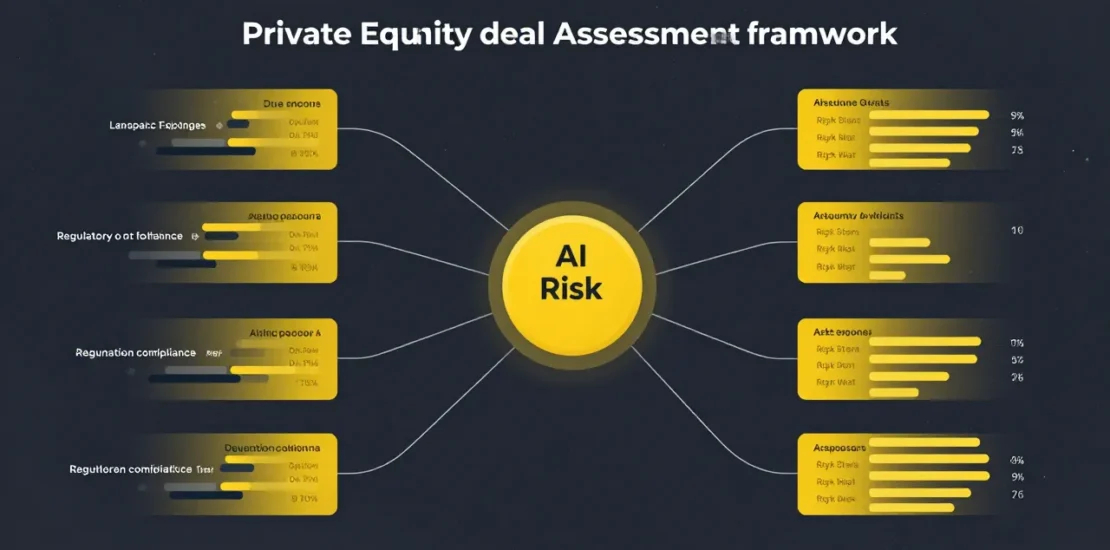
The AI Diligence Framework: Four Categories
Category 1: Regulatory Exposure Assessment
The first question is whether the target’s AI systems are subject to heightened regulatory oversight, and if so, whether the target is compliant.
High-risk sector classification. The EU AI Act and emerging U.S. sector-specific guidance identify categories of AI applications that carry heightened compliance obligations: employment decisions (hiring, firing, performance evaluation), credit and financial services decisions, healthcare clinical decision support, law enforcement, and certain government-adjacent applications. If the target’s AI systems fall into these categories and the buyer intends to maintain or expand those deployments in EU markets or under U.S. sector regulators, the compliance analysis is considerably more complex.
FTC scrutiny of AI claims. The FTC has been aggressive about AI-washing — companies claiming their products incorporate AI capabilities that don’t exist or are significantly overstated. If a target’s revenue depends on AI capability representations, diligence should assess whether those representations are defensible. An FTC enforcement action that undermines a key customer value proposition is a material deal risk.
EEOC and employment discrimination exposure. AI systems used in hiring, performance management, scheduling, or similar employment decisions that result in disparate impact on protected classes create EEOC exposure. The EEOC has issued guidance making clear that employers are responsible for discriminatory outcomes from AI tools even when those tools are purchased from third-party vendors. Assess what employment-related AI systems the target uses, whether bias audits have been conducted, and whether algorithmic impact assessments have been documented.
State AI law compliance. The patchwork of state AI laws — covering algorithmic employment decisions in Illinois and New York, deepfake prohibitions, AI transparency requirements, and data privacy obligations — requires mapping the target’s AI use against the relevant states where it operates. This mapping exercise can reveal compliance gaps that generate post-closing liability.
OFAC and national security screens. If the target uses AI vendors with significant ties to foreign adversary nations, or if its training data was processed through infrastructure with connections to sanctioned parties, OFAC analysis may be required. This is an emerging diligence consideration that is not yet systematically incorporated into most frameworks.
Remediation cost modeling. When compliance gaps are identified, they need to be costed into the acquisition model. If bringing a target’s AI systems into compliance with the EU AI Act’s high-risk requirements costs $3 million and takes 18 months, that is a material consideration in both valuation and deal structure. Gaps should not be treated as qualitative risk items — they should be translated into estimated remediation costs.
Category 2: IP Ownership Analysis
AI intellectual property due diligence is more complex than software IP due diligence because of the multi-layer nature of AI system construction. A target’s AI system may incorporate some or all of the following, each with its own IP implications:
Foundation models. Most commercial AI applications are built on top of foundation models — large pre-trained models from OpenAI, Anthropic, Google, Mistral, Meta, or other providers. The target’s rights to use these models are defined by license or API agreement. Some of these agreements restrict commercial applications, impose usage policies, prohibit certain downstream uses, or include provisions under which the model provider retains rights to use customer inputs. Review these agreements closely.
Open-source components. Many AI system components and tools are licensed under open-source licenses, and some of these licenses (GPL, LGPL, AGPL) impose copyleft requirements that can affect what the buyer can do with the target’s codebase post-acquisition. A target that has built proprietary AI tooling on top of AGPL-licensed components may have obligations to release that tooling as open source — a material IP risk if the tooling is a core competitive asset.
Fine-tuning and training data rights. When a target has fine-tuned a foundation model on its own proprietary data, the question of who owns the resulting fine-tuned model depends on the terms of the underlying model license. Some licenses grant the licensee full ownership of fine-tuned versions; others do not. The target’s training data itself may be subject to confidentiality obligations, third-party data licenses, or privacy law restrictions that limit how it can be used post-acquisition.
Employee IP assignments. Standard employee IP assignment agreements capture inventions created using company resources or related to company business. But they do not always clearly address AI-generated outputs — documents, code, analyses, and other materials produced by AI tools in the course of employee work. Assess whether the target’s IP assignment agreements are comprehensive enough to capture AI-assisted work product.
Model cards and documentation. Well-governed AI systems maintain documentation of training data sources, model limitations, intended use cases, and known biases. The absence of this documentation is itself a risk indicator — it suggests either that the documentation work has not been done or that documented issues are being withheld. Comprehensive model documentation is also increasingly required for regulatory compliance under the EU AI Act and certain sector-specific frameworks.
Output ownership disputes. Multiple copyright registration requests for AI-generated works have been rejected by the U.S. Copyright Office, which maintains that copyright requires human authorship. A target that has attributed significant IP value to AI-generated creative content — product content, marketing materials, software documentation — may be holding assets with contested or no copyright protection.
Category 3: AI Contract Obligations That Transfer With the Business
Change-of-control is a legal inflection point in AI vendor relationships that deal teams frequently underestimate.
Change-of-control provisions. Review every material AI vendor agreement for provisions that address assignment, change-of-control, or successorship. Common provisions include:
- Restrictions on assignment without vendor consent — if the vendor withholds consent, the agreement terminates at closing
- Renegotiation rights triggered by change-of-control — the vendor can insist on new pricing or terms as a condition of continuity
- Automatic termination on change-of-control, creating an obligation to renegotiate from scratch with a potentially leverage-reversed negotiation posture
- Data deletion or data transition obligations triggered by change-of-control
Vendor data retention rights. Some AI vendor agreements include provisions under which the vendor retains the right to use customer data — including proprietary training data — for the vendor’s own model improvement purposes, even after the customer relationship ends. If the target has contributed proprietary data to a vendor’s foundation model training corpus under such a provision, the target’s competitive advantage from that data may have been permanently shared with the vendor and will not transfer to the buyer.
Ongoing audit and compliance obligations. Some AI agreements, particularly those involving healthcare AI, financial services AI, or other regulated-sector applications, include ongoing audit rights, compliance certification requirements, or incident reporting obligations. These obligations transfer with the business and the buyer needs to understand and be prepared to satisfy them.
API rate limits and pricing structures. For AI-native businesses where usage-based API costs are a significant operating expense, review whether current pricing is locked in, indexed to volume, or subject to change by the vendor. Some API pricing structures change materially as volume scales — which is directly relevant to growth modeling.
Indemnification gaps. Assess what IP indemnification the target’s AI vendors provide. The industry survey data cited above finds that only 33% of AI vendors provide indemnification for third-party IP claims. If the target has deployed AI that generates outputs potentially infringing third-party copyrights, and the vendor does not indemnify against those claims, the buyer is acquiring that IP risk without a backstop.
Category 4: AI-Driven Workforce Automation as WARN Act Trigger
For PE acquirers whose investment thesis involves deploying AI to automate functions currently performed by the target’s employees — a common operational improvement plan — the WARN Act and its state equivalents represent a compliance requirement that needs to be built into the operational plan from day one.
Federal WARN Act basics. The Worker Adjustment and Retraining Notification Act (29 U.S.C. §§ 2101-2109) requires employers with 100 or more full-time employees to provide 60 days’ advance notice of plant closings or mass layoffs. A mass layoff is generally a reduction in force of 500 or more employees, or 50-499 employees constituting at least 33% of the workforce at a single site, during any 30-day period. Violations expose the employer to 60 days of back pay and benefits per affected employee, plus civil penalties.
State WARN Act expansions. Multiple states have enacted mini-WARN Acts with lower thresholds and longer notice requirements than the federal law. New York’s WARN Act, for example, applies to employers with 50 or more full-time employees and requires 90 days’ notice. California’s WARN Act applies to employers with 75 or more employees and requires 60 days’ notice.
AI-specific workforce displacement notice requirements. This is a newer and rapidly developing area. Connecticut and New York have enacted requirements that employers provide notice when reductions in force are related to the adoption of AI or automation. California legislation passed in 2025 requires employers to provide advance written notice when AI or automation drives workforce reductions or hiring freezes. These state-specific requirements are in addition to, not in place of, standard WARN Act obligations.
Practical implications for the deal model. The operational improvement plan that drives the acquisition thesis needs to be assessed against WARN Act obligations at the pre-closing stage. If the plan involves reducing the workforce by 15% through AI automation in the first year post-closing, the WARN Act exposure needs to be built into the timeline and the cost model. A 60-day or 90-day notice period means that automation-driven workforce reductions cannot begin until 60-90 days after the termination decisions are made — which affects the operational improvement timeline and the return model.
Collective bargaining implications. If the target has a unionized workforce and automation plans would affect bargaining unit positions, collective bargaining obligations under the NLRA may require bargaining with the union before implementing changes. This can significantly extend the timeline for realizing automation-driven efficiencies.
Deal Structure Considerations
How these risks are priced and allocated in the deal structure matters considerably.
Representation and warranty insurance. AI-specific reps — representations about IP ownership, regulatory compliance, training data rights, and vendor contract status — should be specifically negotiated in the purchase agreement and specifically covered in the R&W insurance policy. General technology reps may not be broad enough to capture AI-specific issues. Work with the R&W insurer to ensure that AI-related risks are within scope.
Indemnification carve-outs and baskets. AI regulatory exposure — particularly for high-risk AI systems subject to the EU AI Act or U.S. sector-specific requirements — may warrant specific indemnification provisions with appropriate survival periods and baskets. If diligence reveals identified compliance gaps, those gaps should be addressed through specific indemnification provisions rather than relying on the general indemnification basket.
Earnout structures for AI-dependent businesses. When a significant portion of a target’s value is attributable to AI capabilities that are still scaling, earnout provisions need to be designed with AI-specific risk in mind — including the possibility that regulatory changes or vendor relationship disruptions could affect AI system performance during the earnout period. The Krafton case (discussed in Post 109 of this series) illustrates how earnout disputes in technology acquisitions can become complex post-closing litigation.
Pre-closing covenants on AI system changes. Include pre-closing covenant provisions that restrict the target from materially modifying its AI systems, entering into new AI vendor agreements, or making significant workforce changes related to automation plans without buyer consent during the period between signing and closing.
Building AI Diligence Capability
The practical challenge for most PE firms is that AI-specific diligence requires expertise that is not traditionally housed in deal teams or traditional legal counsel. Building effective AI diligence capability requires:
- Technical advisors who understand AI model architecture, training data provenance, and AI system documentation
- Legal counsel with experience in AI regulatory frameworks, AI IP, and AI vendor agreements — not just general technology counsel
- Operational experts who can assess AI deployment readiness and the practical path to regulatory compliance
- A structured diligence checklist that covers all four categories above, applied consistently across AI-exposed targets
The cost of building this capability is real. But the alternative — acquiring AI-enabled companies without understanding the AI-specific risks embedded in the business — is the path to post-closing surprises that are both expensive and avoidable.
The Bottom Line
AI is both the investment thesis and the deal risk in an increasing proportion of PE acquisitions. The firms that treat AI diligence as a distinct and structured workstream — covering regulatory exposure, IP ownership, contract obligations, and workforce planning — are acquiring these businesses with their eyes open. The firms that rely on traditional technology diligence to capture AI-specific risks are taking on exposures that their deal models do not price.
The AI risk categories described in this post are not speculative future risks. They are documented sources of post-closing liability in transactions that have already closed, operating companies that have already received regulatory inquiries, and portfolio companies that have already confronted the gap between what their AI vendor agreements say and what they believed they owned.
This post is for general informational purposes only and does not constitute legal advice. Reading this post does not create an attorney-client relationship. If you have questions about your specific situation, consult a qualified attorney.