

North Korean IT Worker Fraud: Deepfakes, Sanctions Risk, and Hiring Compliance
- November 14, 2026
- Posted by: allan
- Categories: AI & Technology Law, Employment Law
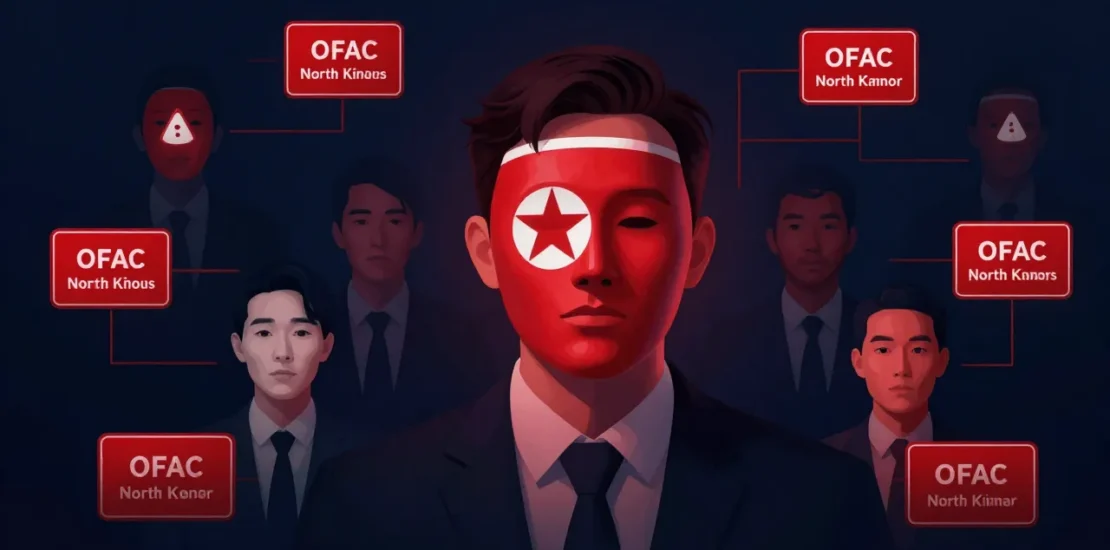
Over the past several years, a persistent and increasingly sophisticated threat has been quietly infiltrating American companies: North Korean nationals posing as freelance software developers and IT contractors, using fabricated identities, AI-generated deepfakes, and elaborate infrastructure to pass hiring screening and gain access to corporate systems, sensitive data, and a steady stream of American payroll dollars routed directly to the Kim Jong Un regime.
This is not a theoretical risk. Prosecutions are ongoing. Federal agencies have issued repeated public warnings. And the companies that hired these operatives — most of them unknowingly — face potential OFAC sanctions liability, IP theft exposure, and in some cases, criminal exposure for the most serious failures of oversight. If your company hires remote IT contractors or engineers, this post is directly relevant to your compliance obligations.
The Scale of the Problem
The North Korean remote IT worker scheme is not a niche issue affecting a handful of companies. According to Microsoft’s June 2025 Security Blog tracking the threat actor it calls “Jasper Sleet,” North Korean remote IT workers have targeted organizations across multiple sectors including technology, defense, finance, and government contracting. U.S. government reports identified over 300 U.S. companies — including Fortune 500 firms — that unknowingly employed these operatives between 2020 and 2022 alone.
The problem has grown substantially since then. Fortune reported in August 2025 that the number of companies that hired North Korean software developers had grown 220% over the prior 12 months, driven in large part by the weaponization of generative AI tools at every stage of the hiring and infiltration process. The IC3 (FBI’s Internet Crime Complaint Center) issued a public service announcement in January 2025 specifically warning about North Korean IT workers conducting data extortion — a newer and more aggressive phase of the scheme.
The Department of Justice announced sweeping nationwide enforcement actions in June 2025, November 2025, and again in April 2026, targeting domestic facilitators who ran what are called “laptop farms” — physical locations in the United States where company-issued laptops were received, logged in, and made to appear to operate from American IP addresses while the actual workers operated remotely from Asia. In June 2025 alone, DOJ announced two indictments, searches of 29 suspected laptop farms across 16 states, and the seizure of 29 financial accounts used to launder illicit funds.
The sentences handed down to domestic facilitators have been severe. Christina Marie Chapman, who ran a laptop farm operation that helped North Korean workers fraudulently obtain employment with over 300 U.S. companies, was sentenced to 102 months in federal prison. In April 2026, Kejia Wang and Zhenxing Wang were sentenced to 108 and 92 months respectively for running a similar scheme compromising over 80 stolen U.S. identities.
How the Fraud Works: A Step-by-Step Look
Understanding the mechanics of this scheme is essential for building effective countermeasures. The operation has grown considerably more sophisticated since the early documented cases.
Identity fabrication. Operatives construct entirely synthetic identities — full names, Social Security numbers, employment histories, LinkedIn profiles, GitHub repositories, and portfolios. Much of this is now AI-generated. Palo Alto Networks’ Unit 42 research group documented in 2025 how synthetic identities can be created at alarming speed using commercially available AI tools, including fabricated profile photos, auto-generated resumes calibrated to pass applicant tracking systems, and manufactured professional histories.
Job platform infiltration. Workers apply through mainstream freelance and staffing platforms — Upwork, Fiverr, LinkedIn, and staffing agencies — often presenting polished profiles with manufactured credentials, fake references, and AI-optimized application materials designed to surface highly in searches.
Deepfake video interviews. This is perhaps the most alarming development. When companies require video interviews, operatives have deployed real-time AI face-swapping technology to present a fabricated visual identity. Voice synthesis tools are used simultaneously, and in some documented cases, AI noise cancellation tools mask environmental sounds (such as the Mandarin or Korean being spoken in the background). Microsoft’s Jasper Sleet research documented cases in which the worker navigated multiple browser tabs during the video interview, feeding interview questions to a large language model in real time to generate responses — creating an additional layer of AI-assisted deception.
Laptop farm routing. After being hired, the worker’s company-issued laptop is shipped to a domestic facilitator — a laptop farm operator in the U.S. — who receives, powers on, and maintains the device. This causes the device to appear to be operating from a U.S. IP address. The actual worker accesses the laptop remotely from overseas, typically from China, Russia, or directly from North Korea.
Multiple simultaneous jobs. Individual operatives routinely hold four, five, or more full-time employment positions simultaneously, using AI coding assistants to maintain productivity across all of them. This is not a side gig — it is a systematized revenue generation operation. The wages from each position are laundered back to the DPRK government.
Data exfiltration and extortion. The most recent phase of the scheme involves operatives who, upon being discovered or terminated, hold proprietary code and sensitive company data hostage, demanding ransom in exchange for not publicly releasing the material. The FBI’s January 2025 IC3 alert specifically warned companies about this escalation. In some instances, companies that fired these workers had their proprietary code released publicly.
The Legal Exposure: OFAC Strict Liability
This is where the legal risk becomes acute. The United States maintains a comprehensive sanctions program against North Korea administered by the Treasury Department’s Office of Foreign Assets Control (OFAC). Under the International Emergency Economic Powers Act (IEEPA) and the North Korea Sanctions Regulations (31 C.F.R. Part 510), U.S. persons are broadly prohibited from engaging in transactions — including employment relationships and compensation — with North Korean nationals or entities acting on behalf of the North Korean government.
The critical legal point every business owner needs to understand: OFAC civil liability is strict liability. A company does not need to have known it was hiring a North Korean national to face civil penalties. The violation is the transaction itself — the paycheck, the contractor payment, the wire transfer. Ignorance is a mitigating factor in penalty calculation, but it is not a defense to the underlying violation.
OFAC’s maximum civil penalty for a sanctions violation is approximately $375,000 per transaction (as periodically adjusted for inflation), or twice the value of the transaction involved, whichever is greater. In an employment context with monthly salary payments over a period of months or years, the aggregate penalty exposure can be substantial.
As of this writing, OFAC has not brought civil enforcement actions specifically targeting companies that unknowingly hired DPRK IT workers. The enforcement focus has been on domestic facilitators who knowingly ran the infrastructure. But that posture can shift, particularly for companies that demonstrate deficient compliance programs — and OFAC has specifically sanctioned the overseas networks that employed these workers, which means the transactional exposure exists as a matter of law even without targeted enforcement action to date.
OFAC also imposed sanctions in March 2026 on a DPRK IT worker network and related entities specifically for their role in funding WMD programs through fraudulent remote employment.
Criminal Exposure: When Does It Rise to That Level?
For most companies, the risk is civil rather than criminal. But criminal exposure can arise in specific circumstances:
-
Actual knowledge. If a company or individual within it knew or had strong reason to know that a worker was a North Korean national and continued to employ and pay that person, that could support charges under IEEPA, wire fraud, or conspiracy statutes.
-
Money laundering. If a company processes payments it knows or should know are going to sanctioned entities, money laundering exposure under 18 U.S.C. § 1956 becomes relevant.
-
Identity fraud facilitation. Companies that knowingly assist in maintaining cover identities — for example, writing false employment verifications — face independent criminal liability.
The domestic facilitators who have been prosecuted demonstrate the outer boundary: the individuals sentenced to eight and nine years in federal prison were not North Korean nationals. They were Americans who knowingly ran the enabling infrastructure.
Detection: What to Look For
Federal agencies including the FBI, CISA, and the State Department have issued guidance on detecting North Korean IT worker infiltration. The following indicators represent the current state of publicly disclosed detection methodologies.
Before and during the interview process:
- Résumés with inconsistencies — work history gaps, skills lists that are unusually broad or mirror job description language precisely, references that cannot be verified or that share common contact information patterns
- Video interview red flags: slight but consistent lip-sync delays, unnatural blinking patterns, skin edges at the hairline or jawline that appear digitally processed, lighting that does not respond naturally to movement, audio that sounds processed or mechanical
- Reluctance to appear on camera at all, or insistence on low-resolution settings that degrade image quality
- Unusual interview time zones — candidates claiming to be in U.S. cities but scheduling interviews during Asian business hours
- Extreme proficiency on technical assessments but awkward, stilted personal conversation
- Multiple applications from the same IP address or with overlapping formatting patterns
After hiring:
- Authentication from IP addresses in China or Russia despite the worker claiming to be located in the U.S.
- Authentication from known commercial VPN providers on a consistent basis
- Company laptop shipping addresses that differ from the worker’s claimed residence and do not correspond to identifiable homes or offices
- Unusually high productivity across odd hours — particularly patterns consistent with multiple time zones
- Requests for elevated system access early in the engagement
- Screen capture tools, remote access software, or cloud storage applications installed without authorization
- Refusal to participate in in-person or live video team meetings
Identity verification red flags:
- Social Security numbers associated with deceased individuals, individuals of very different ages, or multiple applicants
- Residential addresses associated with mail forwarding services, UPS stores, or known laptop farm addresses
- Phone numbers that resolve to VoIP services
- GitHub and LinkedIn profiles with very recent creation dates despite claimed years of experience
A Practical Compliance Framework
Effective compliance with OFAC sanctions in this context requires a combination of process controls, technology tools, and ongoing monitoring. Here is a working framework for small and mid-size companies.
1. Verify identity before any payment. Collect a government-issued photo ID and conduct liveness verification — a live video interaction specifically designed to confirm that the person on camera is the same person depicted in the ID. Several commercial identity verification platforms now offer liveness detection as a service.
2. Require live, on-camera video interviews with specific liveness tests. Ask candidates to hold their ID up to the camera. Ask them to wave or turn their head while speaking. Request that they move to a window to change the lighting. These simple actions disrupt most real-time deepfake pipelines. Ask them to do an unexpected physical action that could not be pre-scripted — hold up three fingers, turn around, show you what’s behind you.
3. Use multiple video platforms. Ask the candidate to join via a different video platform mid-interview. Deepfake pipelines are often optimized for a specific platform; switching mid-call can expose inconsistencies.
4. Independently verify all references and employment history. Use a professional employment verification service. Independently look up claimed prior employers and call main corporate lines — not numbers provided by the applicant.
5. Control device shipping. Ship company equipment directly to a verified residential address and require photo confirmation of receipt via live video or a signed delivery requiring government ID.
6. Require in-person work or regular in-person check-ins for sensitive roles. For contractors with access to sensitive code, infrastructure credentials, or customer data, consider whether fully remote arrangements are operationally appropriate.
7. Monitor device authentication logs. Implement endpoint detection that flags logins from foreign IP addresses, VPN services, or IP addresses previously associated with laptop farm activity. CISA and the FBI have published lists of known indicators of compromise.
8. Conduct background checks with biometric confirmation. Third-party background check providers are increasingly offering checks specifically designed to detect synthetic identity fraud, including SSN validation, death record cross-checks, and address history analysis.
9. Implement access controls and behavioral monitoring for new hires. Contractors should not have full administrative access on day one. Implement least-privilege access policies and monitor for unusual data access or exfiltration attempts, particularly bulk downloads or access to repositories outside the contractor’s assigned scope.
10. Document your compliance program. If a violation is later discovered, a documented, robust compliance program is a significant mitigating factor under OFAC’s Enforcement Guidelines and can reduce penalties substantially. OFAC’s Compliance Commitments framework identifies five essential components: management commitment, risk assessment, internal controls, testing and auditing, and training.
If You Discover a Problem: Response Steps
If your company discovers that it has potentially employed a North Korean IT worker, your response in the first 48 to 72 hours is critical.
Do not simply terminate and move on. The transaction record — every paycheck, contractor payment, and reimbursement — is the evidentiary record of potential OFAC violations. That record is preserved and may be subject to subpoena.
Preserve all records. Do not delete email threads, Slack messages, payment records, or device logs. Engage outside counsel with OFAC and national security experience immediately, before taking further action.
Conduct an internal investigation. Document what the company knew, when it knew it, what controls were in place, and whether they were followed. This investigation record will be central to any voluntary self-disclosure.
Consider voluntary self-disclosure to OFAC. OFAC’s Enforcement Guidelines treat voluntary self-disclosure as a “substantial mitigating factor” and consistently reduce base penalty calculations by 50% or more for qualifying disclosures. Self-disclosure must occur before OFAC independently learns of the violation to preserve the mitigation benefit. Coordinate this decision with counsel.
Report to law enforcement. File a complaint with the FBI’s IC3 (ic3.gov) and consider whether to engage the FBI directly, particularly if you have evidence of a domestic facilitator or laptop farm. Cooperation with law enforcement is independently mitigating under OFAC’s framework.
Assess and remediate the security posture. Assume the worst-case scenario: that the worker had full access to everything they were technically permitted to access. Conduct a forensic audit of what data, code, and credentials the worker accessed or copied. Rotate all credentials. Assess whether customer or employee data was exfiltrated and evaluate data breach notification obligations under applicable state laws and federal statutes.
The Bottom Line for Business Owners
The North Korean IT worker scheme represents a convergence of national security risk, sanctions liability, IP theft exposure, and operational security failure — all arriving through what looks like a routine contractor hire. The AI tools now available to operatives have dramatically raised the sophistication of the deception, to the point where standard hiring processes offer essentially no protection.
The companies best positioned to manage this risk are those that treat identity verification as a compliance function — with documented procedures, technical controls, and ongoing monitoring — rather than a simple HR checkbox. Given the pace of DOJ and OFAC enforcement activity over the past 18 months, this is a compliance gap that can no longer be deferred.
This post is for general informational purposes only and does not constitute legal advice. Reading this post does not create an attorney-client relationship. If you have questions about your specific situation, consult a qualified attorney.