

Planning for an Incident Response Tabletop Exercise
- March 28, 2026
- Posted by: rob
- Category: Data Privacy & Cybersecurity
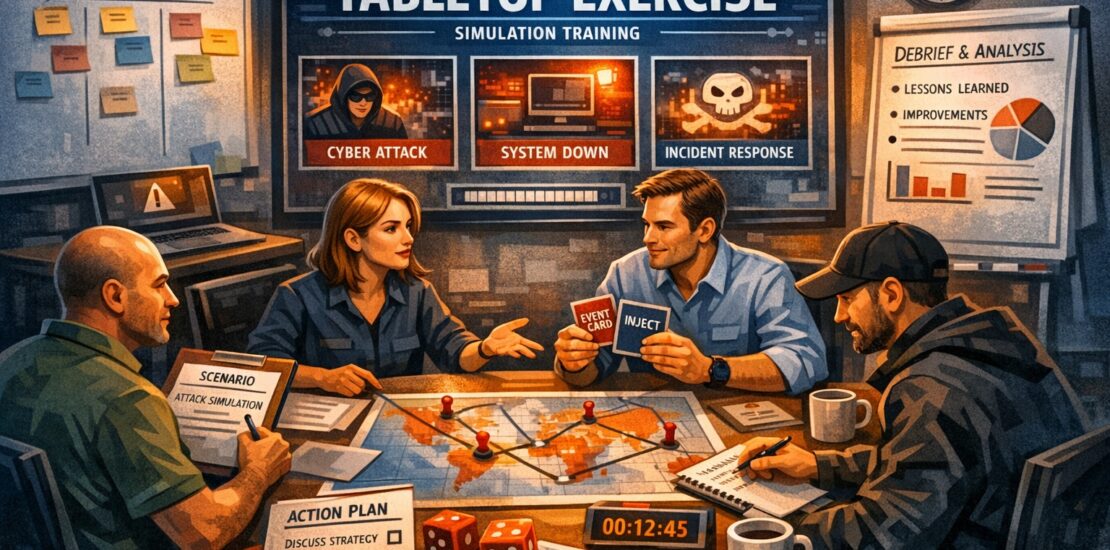
A well‑designed tabletop exercise transforms your incident response plan from a document into a living capability. It allows your organization to rehearse decision‑making, validate processes, and uncover gaps before a real cyber incident occurs. This guide outlines how to plan, structure, and execute an effective tabletop exercise—whether you’re a small business or a publicly traded company.
Why Conduct a Tabletop Exercise?
Tabletop exercises are discussion‑based simulations where participants walk through a hypothetical incident to test their readiness, communication, and decision‑making. They are widely recognized as a core component of cybersecurity preparedness programs.
Who Should Be Involved
Effective tabletop exercises require participation from all functions that would play a role in a real incident.
Core Participants
- IT / Security Operations (SOC/IR team) – Lead technical analysis and response.
- Executive Leadership / C‑Suite – Make high‑impact business decisions; their involvement is critical for realism.
- Legal & Privacy Counsel – Advise on regulatory exposure, privilege, and notification obligations.
- Communications / PR – Manage internal and external messaging.
- HR – Support insider‑related scenarios and employee communications.
- Compliance / Risk Management – Ensure alignment with regulatory and contractual requirements.
- Business Unit Leaders – Represent operational impact and customer concerns.
- Third‑Party Vendors (optional) – Forensics, breach counsel, cyber insurance, or communications firms.
Why Cross‑Functional Participation Matters
Tabletops are not just technical drills—they test the entire organization’s ability to coordinate under pressure. Including non‑technical teams ensures realistic decision‑making and exposes communication gaps.
What Are You Trying to Accomplish?
Before designing the exercise, define clear objectives. Common goals include:
- Testing the incident response plan for clarity, completeness, and usability.
- Improving cross‑functional communication under simulated stress.
- Evaluating decision‑making processes and escalation paths.
- Identifying gaps in tools, logging, monitoring, or documentation.
- Practicing regulatory and contractual notification workflows.
- Strengthening executive readiness for crisis leadership.
- Validating vendor engagement procedures (forensics, counsel, insurance).
CISA’s Tabletop Exercise Packages emphasize that exercises should help organizations understand roles, responsibilities, and information‑sharing processes.
Basic Scenario Development
A strong scenario is realistic, relevant, and tailored to your organization’s environment and risks.
Key Elements of a Good Scenario
- Customization: Use real employee names, systems, vendors, and customers to increase realism.
- An unfolding threat: Information should be revealed gradually, mimicking real‑world uncertainty.
Operational impact: Include service outages, customer complaints, or business disruption.
- Ambiguity: Participants should not have all the facts upfront.
- Pressure: Introduce deadlines, media inquiries, or regulator questions.
Common Scenario Types
- Ransomware with data exfiltration
- Business email compromise (BEC)
- Insider data theft
- Cloud account compromise
- Third‑party vendor breach
- DDoS attack affecting customer‑facing systems
CISA provides extensive scenario templates across cyber, physical, and cyber‑physical domains.
Possible Injections (Plot Twists)
Injections keep the exercise dynamic and force participants to adapt. Examples include:
- New forensic evidence suggesting deeper compromise.
- Unavailable personnel (e.g., IR lead is unreachable).
- Customer complaints escalating on social media.
- Media inquiries requesting comment.
- Regulator outreach asking for details.
- Threat actor communication (e.g., ransom note).
- Backup failure or unexpected restoration delays.
- Law enforcement involvement requesting logs or access.
Injections should be timed to challenge assumptions and test resilience.
Scheduling the Meeting
Planning Considerations
- Duration: 1.5–3 hours is typical for a single scenario.
- Frequency: At least annually; semiannual for regulated or high‑risk industries.
- Format: In‑person, virtual, or hybrid.
- Facilitator: Internal IR lead or external expert to guide discussion and keep pace.
- Pre‑reads: Provide participants with the IR plan, roles, and high‑level scenario context.
- Artifacts: Prepare slides, inject cards, and an after‑action report template (CISA provides templates).
During the Exercise
- Encourage open discussion, not “gotcha” moments.
- Focus on process, not technical troubleshooting.
- Capture decisions, questions, and gaps in real time.
How Tabletop Exercises Differ: Small Businesses vs. Publicly Traded Companies
| Aspect | Small Businesses | Publicly Traded Companies |
| Team Size | Small, often overlapping roles; limited dedicated security staff. | Large, specialized teams with defined IR, legal, compliance, and communications functions. |
| Regulatory Pressure | Fewer mandatory reporting requirements; focus on operational continuity. | Significant regulatory obligations (SEC, SOX, industry‑specific rules). |
| Scenario Complexity | Simpler scenarios focused on ransomware, BEC, or vendor compromise. | Multi‑layered scenarios involving legal exposure, investor relations, and public disclosure. |
| Stakeholder Involvement | Owners, IT lead, outsourced MSP/MSSP. | C‑suite, board of directors, legal, PR, investor relations, risk committees. |
| Documentation Requirements | Lightweight after‑action reports; focus on practical improvements. | Formal documentation, audit trails, and board‑level reporting. |
| Vendor Dependence | Heavy reliance on external vendors for forensics and legal support. | Mix of internal capabilities and pre‑contracted panel vendors. |
Public companies must also consider market impact, disclosure obligations, and reputational risk at a scale small businesses typically do not face.
Conclusion
A well‑planned tabletop exercise is one of the most effective ways to strengthen your organization’s cyber resilience. By involving the right people, defining clear objectives, crafting realistic scenarios, and tailoring the exercise to your organization’s size and regulatory environment, you build the muscle memory needed to respond confidently when a real incident occurs.