
AI and Intellectual Property: Who Owns AI-Generated Content?
- May 24, 2026
- Posted by: allan
- Category: AI Law
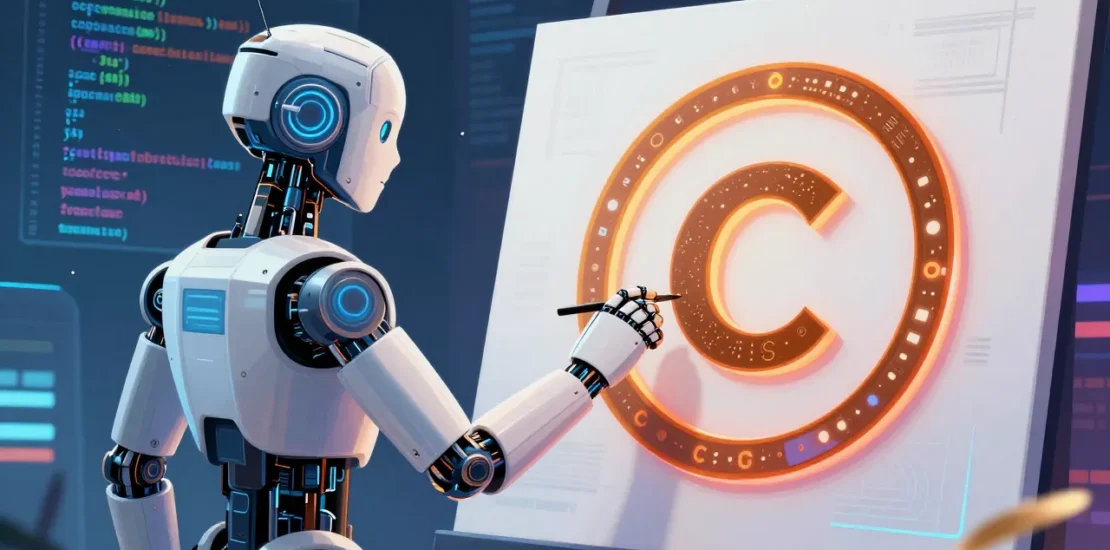
Artificial intelligence tools that generate text, images, code, music, and other creative content have become a routine part of how many businesses operate. Marketing teams use AI to draft copy. Software developers use AI to write and review code. Design departments use AI to generate images and graphics. Legal teams use AI to summarize documents. The convenience and productivity gains are real and significant. But behind every AI-generated output lurks a set of legal questions that most businesses have not yet fully addressed: who owns the content the AI created, can the AI’s output infringe on someone else’s copyright, and what happens if you build your product or brand on AI-generated work that turns out to have no legally protected status?
The Copyright Basics: What the Law Currently Says
Copyright law in the United States protects original works of authorship fixed in a tangible medium of expression. The law has always required that the author of a copyrightable work be a human being. The Copyright Office, which administers the copyright registration system, has stated clearly and consistently that it will not register copyright in works produced entirely by machines without human creative input. Courts have affirmed this position. In the well-known Thaler v. Perlmutter case, a federal court held that the Copyright Office did not err in refusing to register a work generated autonomously by an AI system with no human authorship involved.
The practical implication is significant: if you prompt an AI system to create something and the AI does the creative work, the output may not be eligible for copyright protection in the United States. A work that has no copyright protection is in the public domain, meaning anyone can copy, use, modify, and distribute it without asking permission or paying a license fee. The competitive advantage you hoped to achieve by creating unique AI-generated content may be far less durable than you assumed.
When Does Human Input Create a Copyrightable Work?
The line between protected and unprotected AI-generated content is not drawn at the point where any AI is involved. The Copyright Office and courts have recognized that works incorporating AI elements can be eligible for copyright if there is sufficient human creative authorship. The question is how much and what kind of human input is required.
The Copyright Office has issued guidance stating that it will evaluate AI-assisted works on a case-by-case basis, assessing whether the human contributions are sufficient to constitute original authorship. Writing a detailed prompt that specifies the structure, themes, characters, specific language, and overall organization of a piece of writing may result in a work with sufficient human authorship. Selecting, arranging, and modifying AI-generated elements into a larger work may also create protectable expression in the selection and arrangement. But a person who simply types a generic prompt and accepts the AI’s output without significant creative input or modification is unlikely to have copyright in the result.
For businesses relying on AI-generated content, the practical lesson is to document the creative process. Where human authors wrote some portions and AI generated others, copyright likely attaches to the human-authored portions. Where a human author substantially modified or selected among AI-generated outputs, there may be protectable expression in those choices. Where the AI was essentially operating autonomously, there may be no copyright at all.
Copyright in AI-Generated Code
Software developers have embraced AI coding tools enthusiastically, using them to generate functions, debug code, suggest architectures, and accelerate development timelines. The intellectual property questions surrounding AI-generated code are the same as for other AI-generated content, but the stakes can be higher because software is often the core asset of a technology company.
Code generated by AI without sufficient human creative authorship may lack copyright protection. A company whose software product is substantially composed of unprotected AI-generated code faces the risk that competitors can freely copy that code without infringement liability. For companies building proprietary software, this is a serious business risk that should inform decisions about how extensively to use AI code generation and how to ensure that human developer contributions are substantial and well-documented.
There is also a risk that AI-generated code may reproduce code from its training data in ways that infringe the copyright of the training data’s owners. Early research suggested that AI coding tools could reproduce substantial verbatim portions of the copyrighted code on which they were trained. Whether this constitutes infringement is the subject of ongoing litigation, but it creates real risk for businesses deploying AI-generated code in commercial products without review.
The Training Data Problem: When AI Output Infringes Third-Party Copyright
Large AI models are trained on vast quantities of text, images, code, music, and other content scraped from the internet and other sources. Much of this training data is protected by copyright. The question of whether using copyrighted works to train an AI model constitutes copyright infringement is being actively litigated in courts across the United States. Multiple class action lawsuits have been filed by authors, visual artists, musicians, and other creators against major AI companies alleging that training on their copyrighted works without permission or compensation constitutes infringement.
Separate from the training question, there is also litigation over whether AI models can generate outputs that are themselves infringing. If an AI image generator produces an image that closely resembles a specific copyrighted photograph, or if an AI writing tool generates text that closely tracks a copyrighted book, the output may be infringing regardless of how the AI produced it. The courts are still working through these cases, and the law is genuinely unsettled. But the risk is real enough that businesses using AI-generated content commercially should understand it.
Ownership Provisions in AI Vendor Agreements
Most AI vendor agreements include provisions about who owns the outputs generated by the AI system. In many agreements, the customer is granted ownership of or a broad license to use the outputs. But these contractual provisions only govern the relationship between the customer and the vendor — they do not resolve the underlying copyright questions. A vendor can grant you ownership of AI-generated output, but if that output has no copyright protection, the ownership grant is largely meaningless against third parties.
Vendor agreements may also include representations or indemnification provisions related to the originality of AI outputs and the risk of third-party infringement claims. Understanding these provisions — what the vendor promises, what it disclaims, and how it would handle an infringement claim against you based on AI output — is an important part of evaluating the legal risk of using any AI content generation tool commercially.
Trademarks and AI-Generated Logos
Many businesses use AI tools to generate logos, brand images, and other visual identity elements. A different set of intellectual property issues arises in this context. The trademark system protects brand identifiers — names, logos, slogans — from being used by competitors in ways that cause consumer confusion. Trademark protection does not depend on copyright: a logo that lacks copyright protection because it was generated entirely by AI may still function as a trademark and be protectable as such.
However, the Copyright Office’s position on AI-generated works may affect the ability to register AI-generated logos with the Copyright Office. And the risk of an AI-generated logo resembling an existing brand’s protected mark is real: if an AI logo generator produces a design that closely resembles a competitor’s registered trademark, using that design could expose your business to infringement liability even if you were unaware of the resemblance. Conducting a trademark clearance search before adopting any AI-generated brand identifier is an important step in managing this risk.
Practical Guidance for Businesses Using AI-Generated Content
Given the unsettled state of the law, businesses using AI-generated content should take a few practical steps to manage their intellectual property risk. First, document human creative contributions to AI-assisted works. Detailed prompts, iterative editing, selection among multiple AI outputs, and substantial human modification all support a claim of human authorship. Second, review AI vendor agreements carefully to understand what the vendor promises about ownership, originality, and infringement risk. Third, conduct trademark clearance before adopting any AI-generated brand element. Fourth, do not rely entirely on AI-generated content for your most critical proprietary assets — core software, flagship products, primary brand materials — without involving human creative authorship sufficient to support a copyright claim. Fifth, stay current with the evolving law, because the landscape is changing through litigation and potentially through legislation as well.
The intellectual property questions surrounding AI are among the most dynamic and consequential legal issues facing businesses today. Companies that build their competitive advantage on AI-generated content without understanding these questions are taking legal and business risks that are readily manageable with modest attention and appropriate legal guidance.