
Do I Need a Lawyer to Write My Privacy Policy?
- May 2, 2026
- Posted by: rob
- Category: Data Privacy & Cybersecurity
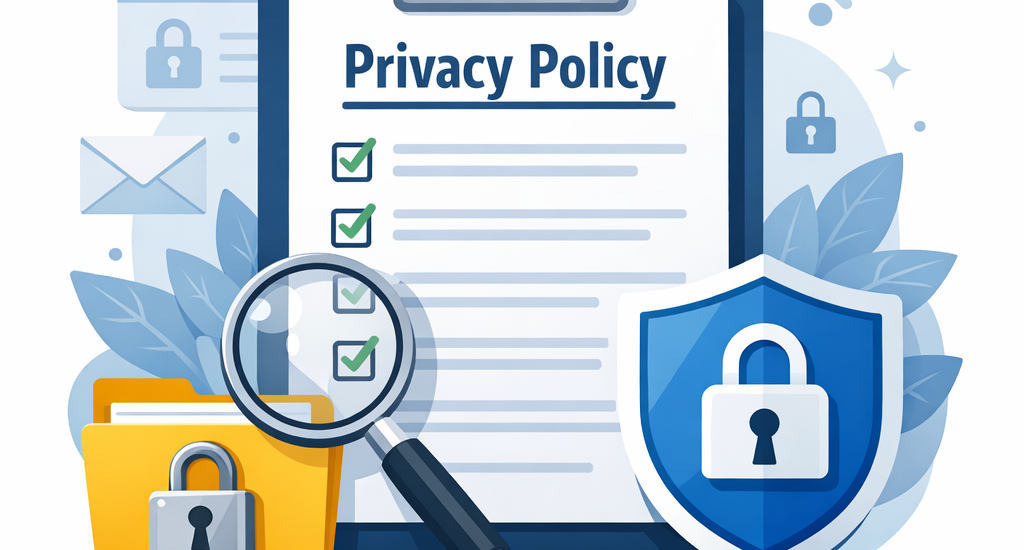
If you have ever launched a website, built a mobile app, or started an online business, you have almost certainly encountered this question. A quick internet search turns up dozens of free privacy policy generators, fill-in-the-blank templates, and AI tools that promise to produce a compliant policy in minutes. The temptation to use them is understandable — they are fast, inexpensive, and they produce something that looks professional enough to paste onto your website. But looks can be deceiving, and when it comes to privacy law, the gap between a policy that looks compliant and one that actually is compliant can be the difference between regulatory approval and a six-figure fine.
The short answer to the question is this: you are not legally required to hire an attorney to draft your privacy policy. But in most cases — particularly if you collect personal data from consumers in California, Europe, or other regulated jurisdictions, or if you operate in a regulated industry — drafting your own policy without legal guidance is a risk that most businesses cannot afford to take. This post explains why.
What a Privacy Policy Actually Is — and What It Is Not
A privacy policy is a legal document. It is a binding statement to your users and customers explaining what personal information your business collects, why you collect it, how it is used and stored, with whom it is shared, and what rights individuals have over their data. It is not a marketing document, and it is not simply a formality that you post on your website to check a box.
Many business owners treat their privacy policy the way they treat the terms of service on software they install — something to click through without reading. That perception is dangerously mistaken, both as a matter of law and as a matter of business risk. Regulators and courts read privacy policies carefully. So do plaintiff’s attorneys. And so do potential investors, acquirers, and enterprise customers who perform due diligence before entering into business relationships with you.
Importantly, a privacy policy is distinct from your terms and conditions (which govern the relationship between your business and its users) and from your internal data governance policies (which govern how your employees handle data). Your privacy policy is the external-facing legal document that creates enforceable obligations about how you handle consumer data — and those obligations run in both directions. If your policy says you do not sell personal information, and you do, that is not just a compliance problem. Under several state laws and FTC authority, it is a deceptive practice that can trigger enforcement action.
When a Privacy Policy Is Required by Law
One of the most common misconceptions about privacy policies is that they are optional — nice to have, but not strictly required. In reality, a wide range of federal laws, state laws, international regulations, and third-party platform requirements mandate privacy disclosures for businesses that meet certain thresholds.
At the federal level, the Children’s Online Privacy Protection Act (COPPA) requires any website or online service directed at children under the age of 13, or that has actual knowledge it is collecting information from children, to post a comprehensive privacy policy and obtain verifiable parental consent before collecting personal information. The Gramm-Leach-Bliley Act (GLBA) imposes similar requirements on financial institutions, mandating specific privacy notices about information sharing practices. Covered entities and business associates under HIPAA must provide patients and plan members with a Notice of Privacy Practices — a document that functions as a highly regulated form of privacy policy.
Beyond these sector-specific laws, the Federal Trade Commission has long used its authority under Section 5 of the FTC Act to pursue businesses whose privacy practices are deceptive. Under the FTC’s framework, if your website or app represents — expressly or implicitly — that you protect user data in a certain way, and you do not, that is an unfair or deceptive act or practice. A privacy policy that overpromises what your business actually does is not a shield; it is evidence of deception.
At the state level, the California Consumer Privacy Act (CCPA), as amended by the California Privacy Rights Act (CPRA), is the most comprehensive consumer privacy law in the United States. It applies to for-profit businesses that meet certain thresholds — including businesses that collect personal information from California residents and have annual gross revenues exceeding $25 million, or that derive 50% or more of their revenues from selling or sharing personal information, or that buy, sell, or share the personal information of 100,000 or more consumers or households per year. Covered businesses must provide detailed privacy disclosures, honor consumer rights to access, deletion, correction, and opt-out of the sale or sharing of their data, and comply with specific notice requirements. The CPRA also created the California Privacy Protection Agency, a dedicated regulatory body with enforcement authority.
California is not alone. Virginia, Colorado, Connecticut, Texas, Oregon, Montana, and a growing number of other states have enacted comprehensive consumer privacy laws, each with their own scope, thresholds, and requirements. Managing compliance across this patchwork of state laws — and ensuring your privacy policy satisfies all of them simultaneously — is not something a generic template can reliably accomplish.
For businesses with customers or users in the European Union, the General Data Protection Regulation (GDPR) adds another layer of significant complexity and risk. The GDPR applies to any organization, regardless of where it is located, that processes the personal data of individuals in the EU in connection with offering goods or services to them or monitoring their behavior. The GDPR requires detailed privacy notices that specify the lawful basis for each category of data processing, data retention periods, the identity of recipients of personal data, information about international data transfers, and a comprehensive description of data subject rights. The fines for GDPR non-compliance are among the most severe in the world — up to €20 million or 4% of global annual turnover, whichever is higher. Major companies have paid hundreds of millions of euros in GDPR fines for inadequate privacy disclosures and practices.
Beyond statutory law, third-party platforms impose their own privacy policy requirements. Apple’s App Store and Google Play both require apps to post a privacy policy that meets their standards. Google’s advertising and analytics products — including Google Analytics and AdSense — require websites that use them to disclose that fact in a privacy policy and, in many cases, to implement specific consent mechanisms. Payment processors and other technology partners frequently impose contractual privacy disclosure obligations as well. Failing to comply with platform requirements can result in app removal or account termination, with immediate business consequences.
What a Privacy Policy Must Typically Include
The specific required contents of a privacy policy depend on which laws apply to your business, but there are several categories of information that appear in virtually every comprehensive privacy policy. Your policy should identify the categories of personal information you collect — this includes not just obvious identifiers like names and email addresses, but also IP addresses, device identifiers, precise geolocation data, browsing history, inferences drawn from consumer behavior, and any sensitive categories of data such as health information, financial information, or biometric data.
The policy must explain why you collect each category of data — the purpose of the processing. It must disclose with whom you share personal information, including service providers, analytics partners, advertising networks, affiliated companies, and any third parties to whom you sell or license data. It must describe how long you retain personal data and the criteria you use to determine retention periods. It must explain what rights consumers have — to access their data, request deletion, correct inaccuracies, opt out of certain processing activities, and receive non-discriminatory treatment for exercising those rights. And it must provide clear contact information for privacy-related inquiries, along with a mechanism for consumers to submit rights requests.
For businesses subject to GDPR, the policy must also identify the specific lawful basis for each processing activity — whether that is consent, contract performance, legitimate interests, legal obligation, or another recognized basis. It must describe international data transfer mechanisms if data is transferred outside the EU. And it must identify the relevant supervisory authority to whom individuals may lodge complaints.
The Problem with DIY and Template Privacy Policies
Given everything described above, it should be clear why a generic privacy policy template — however professionally formatted — poses serious risks. The fundamental problem is that privacy laws are not one-size-fits-all. They apply differently depending on your business model, the categories of data you process, the jurisdictions where your users are located, your industry, and your specific data-sharing arrangements with third parties. A template written for a general e-commerce business will not account for the specific requirements that apply to a health technology company or a financial services firm.
More dangerous still is the scenario where your privacy policy does not accurately reflect your actual data practices. This happens more commonly than people realize: a business copies a policy from a competitor or a template, posts it on their website, and then builds features or engages vendors whose data practices are not disclosed. Under FTC enforcement theory — and under the private right of action available under the CCPA for certain data breaches — this is not just a paperwork problem. A policy that misrepresents your data practices is affirmative evidence of deception, and it can be used against you in both regulatory proceedings and civil litigation.
The FTC has brought enforcement actions against companies with nominally compliant privacy policies for misrepresenting how data was actually used, shared, or protected. State attorneys general have followed suit, and private plaintiff’s attorneys — particularly in California — have become adept at identifying the gap between what a privacy policy says and what a company actually does.
Template policies also tend to be outdated. Privacy law has evolved rapidly over the past several years, and continues to change as new state laws take effect, new FTC rules are finalized, and courts issue decisions interpreting existing statutes. A template downloaded today may reflect the legal landscape from three years ago, which in privacy law is a very long time.
Finally, there is the question of what happens when your business is subject to due diligence — in a fundraising round, a merger or acquisition, or a commercial negotiation with an enterprise customer. Sophisticated investors and their counsel review privacy policies carefully and will identify non-compliant or inaccurate policies immediately. Privacy compliance deficiencies discovered in due diligence can derail a transaction, reduce your valuation, or result in significant indemnification obligations.
What a Good Lawyer Provides That a Template Cannot
An attorney who specializes in privacy law brings several things to the process of drafting your privacy policy that no template or online tool can replicate. First and foremost, a privacy attorney will conduct a data mapping exercise with you — understanding exactly what personal information your business collects, from whom, through what channels, for what purposes, and with whom it is shared. This factual foundation is the prerequisite for an accurate privacy policy, and it is almost impossible to develop without professional guidance.
Based on that data map, your attorney will identify which privacy laws apply to your business and what specific disclosures and practices each requires. They will draft a policy that satisfies all applicable requirements simultaneously — not just the ones that were top of mind when the template was written. They will advise you on consent mechanisms and cookie banner design, which are increasingly subject to regulatory scrutiny. They will review your vendor agreements to ensure that your third-party data sharing practices are properly disclosed and that your contracts with vendors include the required data processing terms.
Beyond the document itself, a privacy attorney advises you on the operational practices that a privacy policy implies: how to handle data subject rights requests, how to respond to a regulatory inquiry, how to structure your data retention and deletion processes, and how to update your policy as your business and the law evolve. A privacy policy is not a set-it-and-forget-it document — it needs to be reviewed and updated whenever your data practices change, new features are launched, new laws take effect, or new vendors are engaged.
When Legal Counsel Is Especially Important
While every business that collects personal information benefits from attorney guidance on its privacy policy, there are circumstances in which engaging a privacy lawyer is not merely advisable but essentially non-negotiable.
If your business operates in a regulated industry — healthcare, financial services, insurance, education, or telecommunications — you face sector-specific privacy obligations layered on top of general consumer privacy law, and the penalties for non-compliance are often more severe. If your product or service is likely to attract minors, or if you have any reason to believe children under 13 may use it, COPPA compliance is mandatory and the FTC has shown a clear willingness to pursue enforcement actions. If you have users in California or the EU, the CCPA/CPRA and GDPR impose obligations with real enforcement teeth. If you process sensitive categories of data — health information, financial data, biometric identifiers, precise geolocation, or information about sexual orientation — the stakes of non-compliance are significantly higher. And if you are preparing for any kind of external scrutiny — a fundraising round, an M&A transaction, an enterprise sales process — your privacy posture will be examined, and deficiencies will have consequences.
The Practical Question of Cost
For many business owners, the decision about whether to engage an attorney comes down to cost. Attorney fees for drafting a privacy policy vary based on the complexity of your business and data practices, your applicable legal framework, and the experience level of the attorney. Simple privacy policies for early-stage businesses with straightforward data practices can be drafted at relatively modest cost. More complex policies — for businesses with multi-jurisdictional obligations, regulated data categories, or sophisticated vendor ecosystems — require more time and expertise and are priced accordingly.
The more useful way to think about cost, however, is in relation to risk. A GDPR fine for a major violation can reach tens of millions of euros. An FTC enforcement action can result in a consent decree that constrains your business operations for years. A CCPA class action lawsuit, even one that settles, can be expensive and disruptive. A failed due diligence review can cost you a financing round or an acquisition. Against those potential outcomes, the cost of having a privacy attorney draft and review your policy is almost always a sound investment.
Conclusion
Privacy policy compliance is not a bureaucratic exercise. It is a substantive legal obligation that carries real consequences for non-compliance — regulatory fines, civil litigation, reputational harm, and failed business transactions. The laws that govern privacy policies are complex, jurisdiction-specific, and rapidly evolving, and they do not make exceptions for businesses that relied on a template they found online.
If your business collects personal information from consumers — and almost every business does — the question is not really whether you need a lawyer to help with your privacy policy. The question is whether the risk of getting it wrong is worth the cost of getting it right. For most businesses, the answer is straightforward.
If you are unsure whether your current privacy policy complies with applicable law, or if you are launching a new product or business and need privacy documentation drafted from the ground up, contact our firm to schedule a consultation. We work with businesses at every stage, from early-stage startups to established enterprises, to build privacy compliance programs that are accurate, enforceable, and designed to grow with your business.